
Initiatives Concerning Human Rights Risks
The Company has established the “Money Forward Group Human Rights Policy” as a policy to promote initiatives of respecting human rights by resolution of the Board of Directors on April 14, 2023. In order to understand the notable human rights risks and the current state of measures of the Group, as part of human rights due diligence, impact evaluations of human rights have been conducted for employees.
Please see the Money Forward Group Human Rights Policy here.
Selection of Human Rights Issues
In order to clarify tangible and potential human rights risks that may occur within the Group, the following human rights risks expected of the Group have been selected.
Human rights issues, discrimination, foreign worker rights, power harassment, sexual harassment, maternity/paternity harassment, care harassment, forced labor, child labor, excessive/long working hours, short/unpaid wages, living wages, freedom of association, safety and health, freedom of expression, privacy rights, and information management concerning gender (including sexual minorities)
Initiatives to identify and evaluate, and measures to prevent and lessen adverse impacts to notable human rights
In order to identify adverse impacts to notable human rights of employees and temporary employees of the Group, referring to guidelines concerning human rights such as the “UN Guiding Principles Reporting Framework,” evaluations of the likelihood of adverse impacts to human rights, the severity of adverse impacts, and scope of adverse impacts and difficulty of correction were conducted, focused mainly on the supervising companies and departments in charge.
The adverse impacts to notable human rights that were identified and evaluated, and the main initiatives to prevent and lessen their occurrences, are as follows.
| Content | Measures to prevent and lessen |
|---|---|
| Harassment |
|
| Discrimination |
|
| Excessive/long working hours Safety and health |
|
Other Initiatives
Training
The Group provides compliance training so that all officers and employees (regardless of whether they are new graduate hires, mid-career hires, part-time or casual employees, interns, temporary employees, or hired under other arrangements) can acquire knowledge on compliance and be more aware of compliance. In addition to touching on human rights risks during training on overall compliance and Code of Conduct, training on harassment prevention is conducted through e-learning programs (incorporating online learning material and comprehension tests).
Please see the dates and attendance rates here.
Hotlines
In order to appropriately respond to compliance violations, including human rights, the Group has established points of contact which enable the Group’s officers and employees to make anonymous reports by means such as email and chat tools, on a violation of laws or ordinances, compliance violations (including a violation of the Group Compliance Rules or other internal rules or a violation of the action guidelines provided in the Money Forward Group Compliance Manual), an act of harassment, or an act that could lead to any of such violations or harassment in the Company and Group companies.
Please see here for details.
Creating a Safe Work Environment
To realize our vision for the society and to steadily increase shareholder value, the Company has set “Talent Forward (Moving Employee Potential Forward)” as one theme of materiality. And so, the Company has organized the five key tenets of our HR philosophy into a strategy that we call the “Talent Forward Strategy.” One of the measures is to “foster a safe work environment and corporate culture,” to strive to create an environment in which employees with different backgrounds and values can feel comfortable working together and respect each other’s differences.
Please see here for specific initiatives.
For disclosure based on TCFD
In order to understand the risks, opportunities, and impacts of future climate change on our business activities, we predicted and analyzed changes in the external environment in accordance with the framework proposed by the Task Force on Climate-related Financial Disclosures (TCFD). As a result, we perceive that there are significant opportunities in our business domains, represented by the potential rise in demand for cloud services, and on the other hand the risks are relatively small. On the opportunity front, we will explore possibilities of expanding our business scope, whereas on the risk front, we will minimize exposure while assessing cost-effectiveness.
*We support TCFD, and Join TCFD Consortium Japan.
Governance
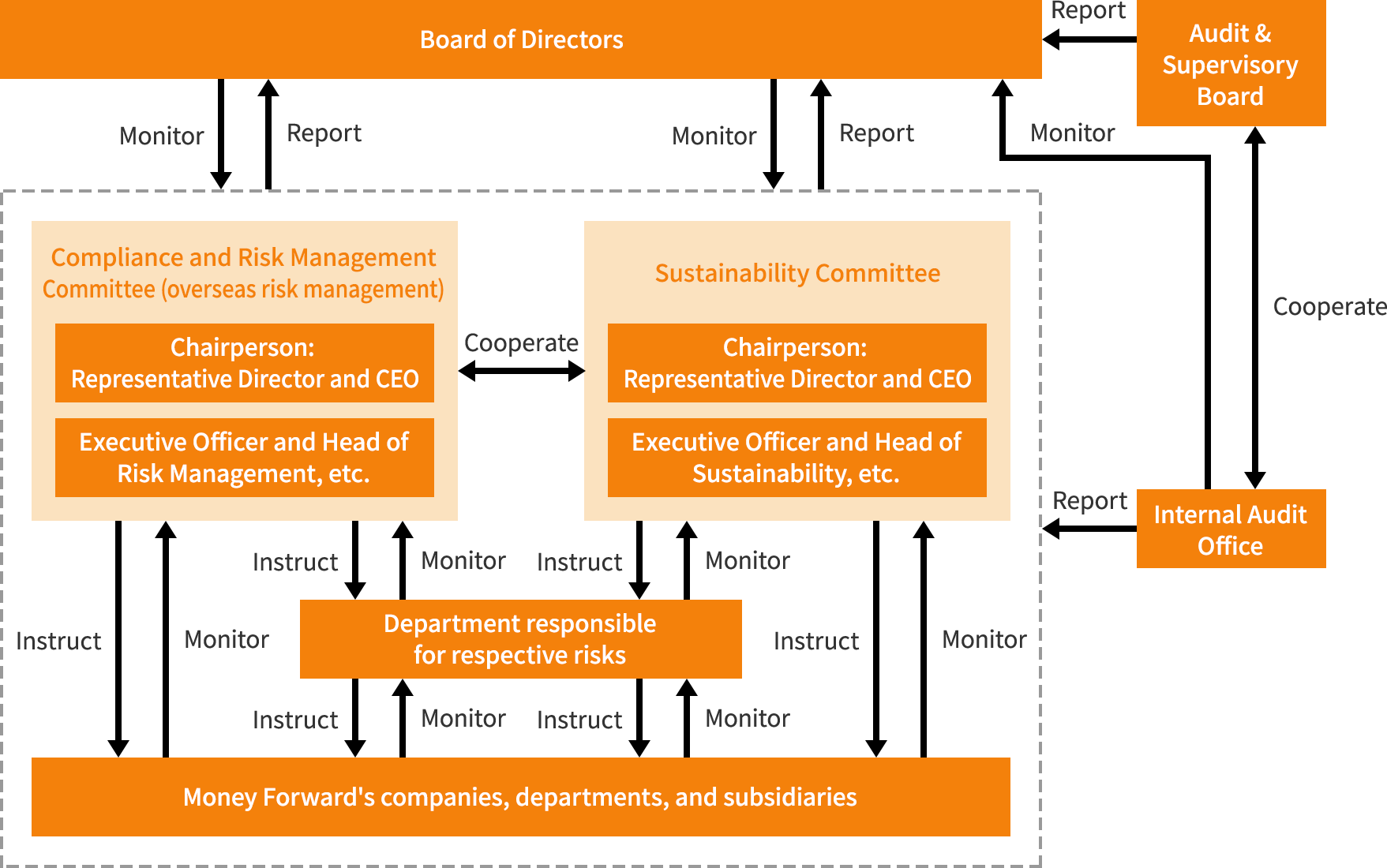
The Company has set up the Group Risk Management Committee and Sustainability Committee under the Board of Directors. Both are composed of members appointed by the board, and chaired by the Representative Director,President and Group CEO.The Group Risk Management Committee oversees risk management, instructs countermeasures to departments responsible for respective risks, and reports the situation to the Board of Directors. Meanwhile, the Sustainability Committee oversees climate change risks, instructs countermeasures to departments responsible for respective risks, and together with the Group Risk Management Committee reports the situation to the Board of Directors. The Internal Audit Office checks and supervises the overall risk management structure and status from an independent standpoint.
Strategies
Money Forward Group conducted an analysis based on future climate scenarios to evaluate the impact of climate change on our business.
In our analysis, we referred to scenarios published by international organizations such as the International Energy Agency (IEA) and the Intergovernmental Panel on Climate Change (IPCC). The Sustainability Committee and the Group Risk Management Committee collaborated to evaluate the risks and opportunities for the Group’s business. The identified risks and opportunities, along with their respective countermeasures, were resolved by the Sustainability Committee and subsequently reported to the Board of Directors.
We will continue to conduct regular scenario analyses to understand the business impact of climate change and strive to strengthen our response.
Scenarios and Reference Materials
| Category | Scenarios Used | Key Risks Analyzed |
|---|---|---|
| 1.5°C to 2°C Scenario | ・IEA Net Zero Emissions by 2050 Scenario / Announced Pledges Scenario ・IPCC SSP1-1.9 / SSP1-2.6 | Transition Risks (Policy, Market, Reputation) |
| 4°C Scenario | ・IPCC SSP5-8.5 | Physical Risks (Acute, Chronic) |
Identification of Risks
1.5°C to 2°C Scenario
| Category | Type | Scenario | Main Risks | Time Horizon | Financial Impact | Countermeasures |
|---|---|---|---|---|---|---|
| Transition Risk | Policy & Legal | Introduction of carbon tax | Increased tax burden due to carbon tax | Mid to Long-term | Low | Reduction of GHG emissions |
| Market | Rising renewable energy prices | Increased costs for procuring renewable energy | Mid to Long-term | Low | Cost reduction through diversification and optimization of power procurement sources | |
| Reputation | Acceleration of ESG investment | Difficulty in fundraising from financial institutions and investors if climate change measures are deemed insufficient | Mid to Long-term | Low | Enhancing information disclosure and maintaining appropriate dialogue with financial institutions and investors |
4°C Scenario
| Category | Type | Scenario | Main Risks | Time Horizon | Financial Impact | Countermeasures |
|---|---|---|---|---|---|---|
| Physical Risk | Acute | Intensification of natural disasters | Service disruptions due to office or data center failures caused by natural disasters; costs for facility repairs, etc. | Mid to Long-term | Low to Mid | Strengthening Business Continuity Planning (BCP) and disaster prevention measures |
| Chronic | Rise in average temperature | Instability of power supply; increased costs for electricity consumption | Mid to Long-term | Low to Mid | Strengthening initiatives to improve energy efficiency |
Identification of Opportunities
| Category | Type | Scenario | Main Opportunities | Time Horizon | Financial Impact | Countermeasures |
|---|---|---|---|---|---|---|
| Products & Services | Existing | Changes in customer behavior | Increased demand for eco-friendly services | Short to Long-term | High | Expanding cloud services and responding to increased demand |
| New | Mid to Long-term | Low to High | Creation of new businesses addressing climate change |
- * Definitions for Time Horizon and Impact Degree
Time Horizon: Short-term = Within 3 years; Mid-term = 3 to 10 years; Long-term = 10 years or more.
Financial Impact (Risk): Low = Limited decrease in revenue or additional costs; Mid = Continuous impact on performance/business; High = Significant impact concerning the company’s survival.
Financial Impact (Opportunity): Low = Limited increase in revenue; Mid = Strengthening of the business foundation; High = Significant effect as a growth driver. - Identification of Opportunities
- * Since opportunities can manifest under both scenarios, they are organized as common items.
Risk Management
Regarding climate-related risks, the Sustainability Committee, in coordination with the Group Risk Management Committee, conducts reviews and monitoring as appropriate through ERM activities and the aggregation/analysis of environmental data, while considering the external environment.
Furthermore, a flow has been established to report and provide recommendations to the Board of Directors based on the importance of the risks.
Indicators and Goals
The Group calculates GHG emissions as an evaluation metric for climate change. For historical GHG emissions data, please refer to our ESG Data.
Money Forward Group’s GHG emissions*1
- Item
- FY2025
- Scope 1(Direct emissions from fuel use, etc.)
- ー
- Scope 2(Indirect emissions from purchased electricity use)*2
- 544(t-CO2)
- Scope 3(Other indirect emissions)*3
- Category 1(Emissions associated with the use of data centers for purchased goods and services.)*4981(t-CO2)Category 7(Employee commuting)306(t-CO2)
- *1
- Boundary: Money Forward, Inc. and all consolidated subsidiaries.
- *2
- Location-based.
- *3
- Disclosed on a phased basis starting from FY2023. Environmental impact has been reduced through the use of data centers powered by renewable energy.
- *4
- Figures for FY2025 are preliminary.
The Group has set a goal of achieving net-zero GHG emissions (Scope 1+2) from its business activities. Due to the nature of our business, we do not emit GHG for Scope 1. For Scope 2, we have achieved virtually zero GHG emissions at all domestic sites since FY2023, and at all sites including overseas locations since FY2025. Specifically, our Tokai Branch and Nagoya Development Site directly procure 100% renewable energy, while other domestic sites utilize FIT Non-Fossil Certificates with tracking, and overseas sites utilize I-REC (International Renewable Energy Certificates).
Other Major Initiatives
- Internal Initiatives
- ・Achieving diverse workstyles, such as the introduction of remote work
- ・Moving internal workflows (internal approvals, expense settlements, contracts, invoicing, etc.) to the cloud
- ・Proactive use of data centers powered by renewable energy
- Initiatives Through Our Services
- ・Contributing to the Digital Transformation (DX) of society through Money Forward Group services
- ・Initiatives to visualize environmental impact utilizing Fintech (Patented)